





Trump declares national emergency 2 weeks after calling coronavirus concern a 'hoax'
Trump made the decision following intense pressure from health experts and criticism over his handling of the ongoing outbreak.
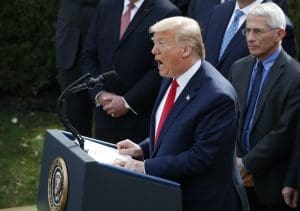
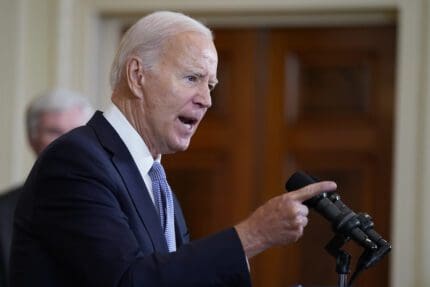
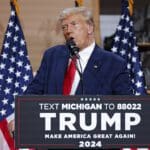
On Friday, Donald Trump announced that he is finally — and according to some, belatedly — declaring the coronavirus a national emergency.
“I am officially declaring a national emergency,” he said, speaking to reporters in the Rose Garden. He added that the move will open up nearly $50 billion for state and local governments to respond to the growing crisis.
Trump also said he was granting Health and Human Services Secretary Alex Azar emergency authority to waive federal regulations and laws that will give doctors and hospitals “flexibility” in treating patients.
The decision comes after growing pressure to do so from the American Hospital Association, American Nurses Association, and American Medical Association, as well as many others, and as schools and local governments close down across the country.
It seemed at last that Trump was finally taking seriously what the World Health Organization earlier this week called a pandemic.
That was not the case two weeks ago, when Trump was busily downplaying the threat, insisting that it would soon be over, and complaining about criticism of his handling of the situation.
“The Democrats are politicizing the coronavirus,” he said at a South Carolina campaign rally on Feb. 28.
“One of my people came up to me and said ‘Mr. President they tried to beat you on Russia, Russia, Russia. That didn’t work out too well.’ They couldn’t do it. They tried the impeachment hoax that was on a perfect conversation,” he said. “This is their new hoax.”
The day before, he had insisted that there were only 15 people in the United States who had tested positive, and “the 15 within a couple of days is going to be down to close to zero. That’s a pretty good job we’ve done.”
At the time of Trump’s Friday press conference announcing the national emergency, 1,629 people had tested positive, according to the Centers for Disease Control and Prevention. Forty-one people have died.
Forty-six states and the District of Columbia have reported cases.
Earlier this week, Dr. Anthony Fauci, director of the National Institute of Allergy and Infectious Diseases, said “things will get worse than they are right now.”
Trump has resisted calls from health experts and even members of his own party to take the ongoing outbreak seriously and to stop minimizing its threat. On Thursday, he mocked Democratic presidential candidates Joe Biden and Bernie Sanders for canceling campaign rallies.
As recently as Friday morning, Trump was still pushing the claim that President Barack Obama is somehow to blame for the crisis. He falsely said Obama made it harder to test for viruses and that he had made the 2009 H1N1 flu outbreak worse by not declaring a state of emergency early enough.
That, as many were quick to note, was also false.
Published with permission of The American Independent Foundation.
Recommended

Ohio doctors fear effects of emergency abortion care case set to go before U.S. Supreme Court
A federal law that allows emergency departments to treat patients without regard to their ability to pay will be under U.S. Supreme Court scrutiny this week, and Ohio doctors are concerned about the case’s local impact on emergency abortion care.
By Susan Tebben, Ohio Capital Journal - April 23, 2024
House GOP votes to end flu, whooping cough vaccine rules for foster and adoptive families
A bill to eliminate flu and whooping cough vaccine requirements for adoptive and foster families caring for babies and medically fragile kids is heading to the governor’s desk.
By Anita Wadhwani, Tennessee Lookout - March 26, 2024
U.S. House Speaker Johnson says IVF should be protected — just not by Congress
U.S. House Speaker Mike Johnson said Thursday that it’s up to states and not Congress to preserve access to in vitro fertilization, weighing in on a growing national debate and campaign issue.
By Jennifer Shutt, States Newsroom - March 14, 2024