





Maker of emergency contraception pill expands access post-Roe
The maker of Julie, an FDA-approved emergency contraceptive, is providing support to historically underserved communities with a new 1:1 donation program.

The emergency contraception company Julie began working on its product prior to the U.S. Supreme Court’s decision overturning Roe v. Wade in June 2022. But once the court announced its decision, it was ready.
As states began implementing abortion restrictions, the head of impact and innovation at Julie, Talia Halperin, tells the American Independent Foundation, the company began to reach out to clinics and reproductive health care networks in those areas to offer the product.
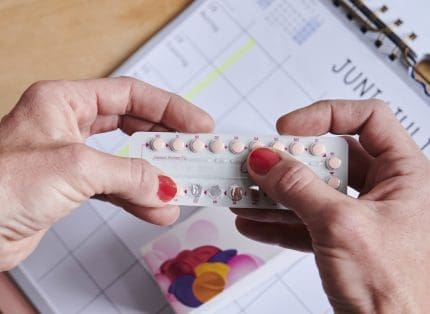
Like other more well-known emergency contraception brands such as Plan B, Julie consists of one pill, containing 1.5 mg of the drug levonorgestrel to be taken after unprotected sex. The contraception prevents fertilization of an egg by sperm.
“What we really try to emphasize is emergency contraception works by delaying ovulation,” Halperin said. “We also really try to emphasize that it’s different from the abortion pill. … The other things that we emphasize, other than how it works and how it prevents ovulation and things like that, is also how to take it and how to take it so it’s most effective.”
Julie can be ordered online through the company’s website and purchased in most pharmacies without a prescription.
What sets Julie apart from other brands such as Plan B, Mirena, and Kyleen, is the company’s 1:1 donation program, designed to get emergency contraception into the hands of anyone who needs it — regardless of economic status.
For every box of Julie purchased, another box is donated to health centers, shelters, sexual assault and crisis response programs, and college campuses.
“We’ve donated over 200,000 units. We’re the largest donor of EC in the country. This is the first and only program of its kind. We have over 70 partners in all 50 states, and we’ve really created a diverse network of partners,” Halperin said. She went on:
When we were first creating the program, one of the first stats that we got really fascinated by was the reproductive desert, a contraceptive desert, over 19 million women living in them. They don’t have a health center with access to all forms of contraception within their zip code. So where we started finding our donation partners was really those zip codes and really those areas where contraception is not available.
According to Power to Decide, an organization that works to provide young people with reproductive health care, there are over 66 million people of reproductive age (13-44) living in the U.S., and over 19 million live in places that “lack ‘reasonable access’ to a health care center with the full range of contraceptive methods.”
With his third executive order on reproductive health care access post-Roe, President Joe Biden set his sights on protecting contraception.
According to a press release issued by the White House, Biden’s June 23 order directs the secretaries of the treasury, labor, and health and human services to “consider new guidance to ensure that private health insurance under the Affordable Care Act covers all Food and Drug Administration-approved, -granted, or -cleared contraceptives without cost sharing and to streamline the process for obtaining care women need and want.”
Several Republican lawmakers around the country have made it their mission to kill access to over-the-counter emergency contraception and have made the false accusation that it is abortion medication.
During his unsuccessful run in 2022 for attorney general of Michigan, Republican Matthew DePerno was recorded saying that Plan B should be banned: “You have to stop it at the border. It’d be no different than, like, fentanyl.”
According to the National Women’s Law Center, during the 2022 federal appropriations process, Republican Rep. Lauren Boebert attempted to make it illegal for public funding to be used to purchase “abortifacient contraceptive drugs.” The center notes, “While these amendments have been unsuccessful thus far, their very existence is problematic since the term is unscientific and made-up, meant to mischaracterize birth control and prey on abortion stigma.”
In December 2022, the Food and Drug Administration updated the information contained on every box of emergency contraception to clarify that the pills do not stop a fertilized egg from implanting in the womb and that it “will not work if a person is already pregnant, meaning it will not affect an existing pregnancy.”
Published with permission of The American Independent Foundation.
Recommended

Biden campaign launches new ad focused on Affordable Care Act
Former President Trump has said he wants to do away with the popular health care law.
By Kim Lyons, Pennsylvania Capital-Star - May 08, 2024
Ohio doctors fear effects of emergency abortion care case set to go before U.S. Supreme Court
A federal law that allows emergency departments to treat patients without regard to their ability to pay will be under U.S. Supreme Court scrutiny this week, and Ohio doctors are concerned about the case’s local impact on emergency abortion care.
By Susan Tebben, Ohio Capital Journal - April 23, 2024
House GOP votes to end flu, whooping cough vaccine rules for foster and adoptive families
A bill to eliminate flu and whooping cough vaccine requirements for adoptive and foster families caring for babies and medically fragile kids is heading to the governor’s desk.
By Anita Wadhwani, Tennessee Lookout - March 26, 2024